Corruption Beyond Cord’s Arm
Graazt’s domain is corruption bound beneath his barbed-wire leash, where Entropy spouted its filth into shape: a scar upon Thera’s body and a living insult to Creation. Beyond Cord’s Arm, beyond the last light of the southern nations, Othmog spreads in a vast madness of abyssal plains, flesh-shredding ridges, poisoned marshes, shattered mountains, and canyons so deep that even sound chokes in terror, unable to return. There is never peace in Othmog, and no hour in which something is not being devoured, torn apart, or corrupted into a more hideous form. To describe it as a kingdom would be folly. It is an endless battlefield where existence is punished and the strong barely survive.
It is an endless battlefield where existence is punished and the strong barely survive.
Before the North Ride War
I do not know whether any map can truly hold Othmog, for maps belong to reason, and Othmog is reason’s desecration. Before the North Ride War tore fresh wounds through demonkind and light scorched part of its surface, Othmog stood at the height of its abominable might. The land crawled with demons in numbers too vast for reason. Hordes of lesser fiends darkened the valleys like locust swarms, while winged predators circled above rivers of blood and monstrous demon lords strode with footsteps that could flatten towers. Through its black marshes moved insects the size of hills, towering horrors whose legs uprooted trees and whose mandibles could shear through stone. Serpents long enough to coil around broken peaks and carrion birds with human faces fed upon the soulless. Petitioners, slaves, and soul crystals were driven in caravans through the wastelands as walking provisions: food for greater demons, fuel for rituals, breeding stock for corruption, and living vessels from which souls were drained.
Law of the Strongest
Othmog’s nature surpasses even Helkor’s ambition for the complete conquest of Therasya and its hatred for the South. It is total insanity, fueled by a voracious appetite. Helkor still remembers the usefulness of walls, ranks, and hierarchy. Othmog abides by no law except the will of the strongest horror. Demon lords carve dominions from one another’s flesh and lose them the same way. Alliances are born and end in betrayal, while blood flows in rivers. Whole regions may belong to one abyssal tyrant at Theril’s peak and be consumed by another before Theril’s shadowed crown devours the morning light. Rivers carry not clear water but sludge, blood, venom, and ash. Water is poison, a breeding pool that hatches new horrors. Lesser fiends devour one another for favor, and greater ones wage wars to prove to Graazt that their cruelty exceeds all rivals. Were Chaos not Othmog’s ultimate ruler, it is doubtful the South could withstand its onslaught.
Wastes of Living Madness
I have gazed upon the reaches beyond the Wall and walked the burned ash. No mortal description can hold the monstrous remains my company encountered. Othmog’s landscapes are as mad as its master. There are fields of black glass where armies once burned from the fury of Behemoths, plains of red dust made from ground bone, and ravines where the walls pulse like diseased flesh. In certain regions the air itself is corruptive, entering the lungs like hot oil and leaving behind fevered dreams or mutations by Theril’s next peak. Forests of thorn and sinew grow from pits where corpses were heaped for centuries. Great spawning trenches open and close like mouths in the earth, vomiting forth beasts, larvae, and malformed demons that tear each other apart before the stronger survive. Light, the cleansing death of demons, does not exist here. It is wholly consumed by Theril, and only those adapted to this true darkness can see.
Ahriman
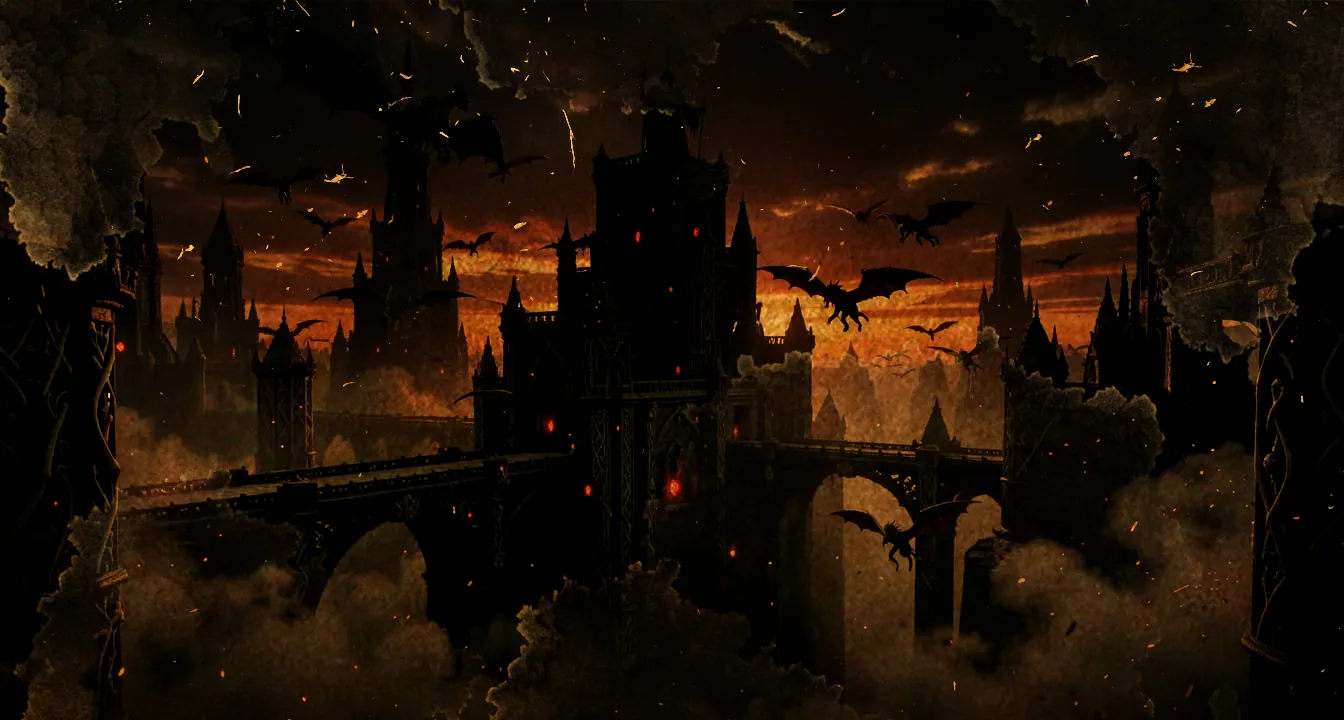
At the black heart of this realm beats Ahriman, Graazt’s dreadful palace-city, sinister beyond mortal measure. I have read in Asha’s Chronicles: “No child of Harmony can call the demon capital beautiful, yet it commands a terrible majesty.” Ahriman is not built as men build cities. Its foundations were laid upon conquered abyssal rock, and its walls were fused from black stone, obsidian, soul crystals, and bone. Its towers rise like insults against a sky the color of burning grease. Bridges hang over chasms filled with sacrificial smoke. Vast courtyards are paved with plates of petitioners’ skin and glass, beneath which damned shapes can still be seen moving. The fortress-palace itself climbs in impossible tiers, each level more forbidden than the last, crowned by halls where demon dukes crawl for favor and the screams of mortals echo through the pillars. From afar, it resembles a citadel constructed out of hatred for Creation. Within its galleries, trophies of fallen angels hang as decorations, and living prisoners are served to fiends in grotesque banquet halls. All paths lead to the throne chamber, lit by the dull glow of countless soul crystals.
Graazt’s Dominion
Graazt’s power gave Othmog what demons lacked: direction, forced cohesion and an iron grip. The Dark Prince is the one demon lord cunning enough to turn this madness into a weapon. Under his shadow, the endless carnage of Othmog was bent toward enemies within and to the South. Rivals were turned against one another, wars were prolonged until both sides were fit for harvest, and soul tribute from mortal lands was drawn northward into his deep coffers. Demons feared him because he could dominate his own rage and loved him because he gave their cruelty purpose. In Ahriman, his voice could send hosts marching across entire regions simply because his will was more terrible than their hunger.
The Uncivilized Abyss
Yet not even Graazt managed to civilize Othmog. No one could. He merely sat atop the madness like a crowned vulture over a battlefield. Beyond the reach of his fortress, other lords still tore at the edges of his dominion, colossal beasts wandered free, and carnage remained the true language of the land. There are no innocents in Othmog, only degrees of damnation. Even its lesser servants learn quickly that mercy is suicide and weakness is the most unforgivable sin. This is why every southern child is taught to fear what lies beyond Cord’s Arm, for Othmog is what the world will become if Entropy consumes Creation.
There are no innocents in Othmog, only degrees of damnation.
Eolon’s Warning
I have seen horrors, fought demons in the Plane of Nightmares beside my friends, and entered ruins where no mortal should tread. None have taught me dread as Othmog did. It is the place where all things are measured only by how loudly they scream before they are shredded. Should light ever fail again, it is not merely invasion that awaits the South, but the destruction of life and reason itself. —Eolon of Oemon, Master of Scarabs
Notable Settlements - Locations
- Ahriman — Graazt’s dreadful palace-city and the black heart of Othmog. It is not a city in the mortal sense, but a fortress-capital of obsidian, bone, soul crystals, sacrificial bridges, demon courts, banquet halls, and Graazt’s throne chamber.
- The Black Marshes - Poisoned wetlands where colossal insectoid horrors move through sludge, blood, venom, and ash. These marshes can serve as demon breeding grounds, hunting territories, or contested dominions of lesser demon lords.
- The Great Spawning Trenches — Living wounds in the earth that open and close like mouths, vomiting forth larvae, beasts, and malformed demons. They are one of the clearest “breeding sites” of Othmog’s endless horror.
- Fields of Black Glass — Burned plains where armies were once destroyed by Behemoths. The ground is fused into dark glass, possibly holding trapped souls, broken weapons, or buried relics from forgotten wars.
- Red Bone Plains — Plains of red dust made from ground bone. These can function as a vast battlefield, corpse-road, or ritual site where demons grind the remains of the defeated into the land itself.
- Flesh Ravines — Canyons whose walls pulse like diseased flesh. They are ideal for forbidden passages, demon lairs, hidden rituals, or places where the land itself reacts to trespassers.
- Forests of Thorn and Sinew — Groves grown from centuries of corpses, half-plant and half-flesh. They could hide demon cults, lost prisoners, corrupted dryads, or ancient battlefield secrets.
- Soul Roads — Caravan routes where petitioners, slaves, and soul crystals are driven toward Ahriman as food, ritual fuel, and tribute. Not a settlement, but one of the most important recurring features of Othmog’s “economy.”
- Desert of Helgut - A vast cold lifeless expanse where only demons can survive. Infested by corrupted haze monsters.
Adventure Hooks
- Graazt allows a lesser demon lord to rebel, knowing the rebellion will expose hidden enemies. The party is drawn into the deception and must decide whether weakening Graazt’s rival actually strengthens Graazt himself. — A survivor returns from Othmog changed by corruptive air, carrying fevered visions of an opening beneath the Wall. His body is becoming a map. — A fallen angel’s remains, a living saint, is displayed in Graazt’s palace-city. The party must enter Ahriman to retrieve one soul before it is served in a banquet hall. — Two abyssal tyrants are fighting over a borderland near Ahriman. A southern alliance wants the party to prolong the war, assassinate one lord, or steal proof that Graazt is manipulating both sides. — A caravan of petitioners and soul crystals is being driven toward Ahriman. The party must decide whether to rescue the captives, destroy the crystals, or follow the caravan to discover which southern lord is secretly feeding Graazt’s tribute.