Lydoria is a harsh and controversial realm ruled by the daughters of the ancient revolt against Avaton. The women who govern the land have built a society around warfare, bloodline, horses, and a freedom that belongs first to women and only rarely to anyone else. Men exist mostly as slaves, laborers, breeders, or gladiators, their value measured by strength, usefulness, and survival.
Outsiders often speak of Lydoria with disgust, fear, fascination, or all three at once. Yet none can deny the power of its mounted armies, the ferocity of its Spearmaidens, or the strange beauty of Porphyria when its crimson banners rise above the southern sea. This is a kingdom born from chains broken by Aloria, and it has never forgotten the sound they made when they fell.
History & Founding
The story of Lydoria begins with Aloria, born in Porphyro village, named Ierion, during the cold and unrest that tore through Aenarch lands. At fourteen, she broke the chains of patriarchy in the Night of Freedom, freed the women who followed her, and gave them a new name: Lydorians, “Women with no Men” in the old Karchaic tongue.
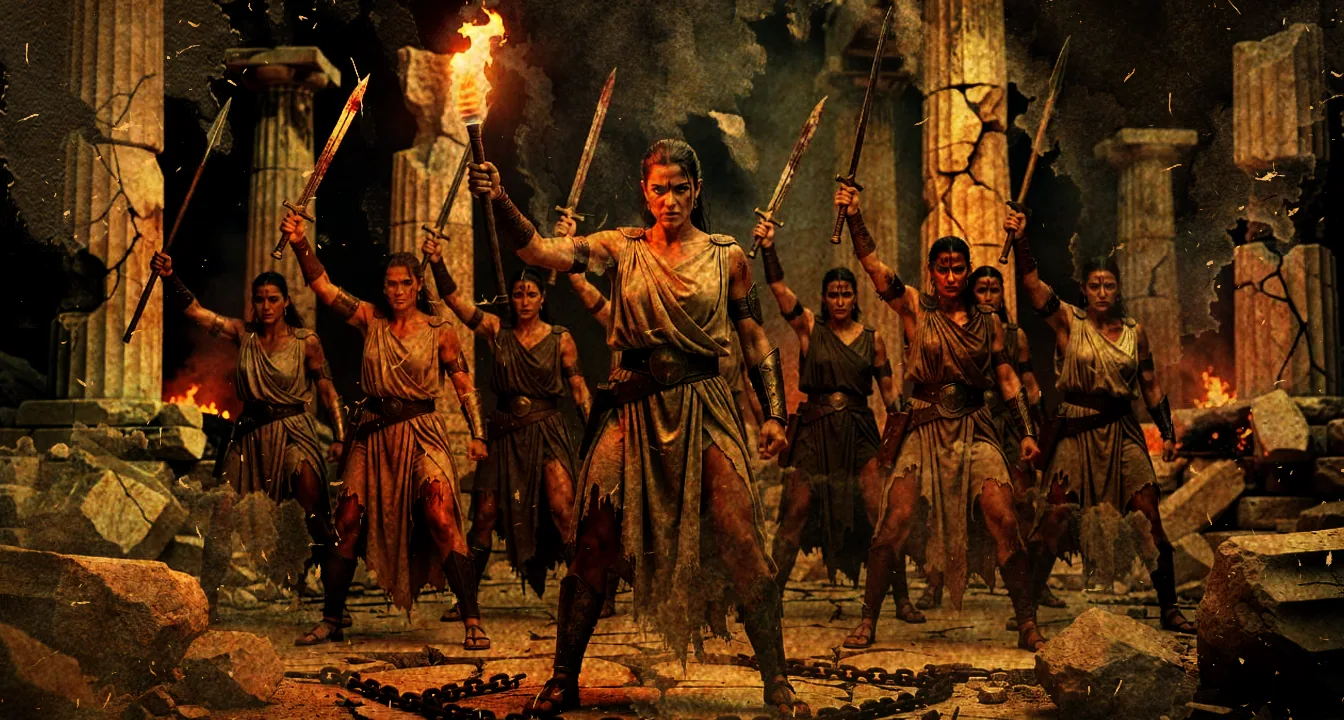
With Avaton behind them and no future left among the Aenarchs, Aloria led her liberated warriors south toward the Lands of Gryphon and then east, beyond the Medusa plains. Around the woods of Amphionas’ river they raised their first banners, and there Porphyria became the heart of the new realm. The timeline places Lydoria’s formal foundation in 1260 BS, after the Night of Freedom and Aloria’s first victories, when her followers claimed their own lands and forged a warrior matriarchy under spear-law, bloodline, and the cult of Aloria.
Lydoria survived by refusing gentleness as a law of life. Its armies fought beside other southern realms when the Fallen and demonic hosts threatened all free nations, yet its inner customs remained severe, proud, and alien even to its allies. To this day, Avaton remains both origin and enemy: the land from which they fled, and the rival whose shadow still sharpens their spears.
Government & Succession
Lydoria is ruled by the Amazon Queen from the Acropole of Porphyria. She is not merely a monarch but the victorious embodiment of Aloria’s Testament, expected to be warrior, judge, mother of the realm, and first spear of the nation. The present ruler is Queen Eryphili III, a former Spearmaiden who won the Aristia four years before Eolon’s visit and remains popular among the warrior castes.
Succession is decided through the Aristia, a sacred and brutal trial held after the death of a queen, her inability to rule, a grave violation of law, or the passing of seven years since her ascension. During this week of challenge, Amazons from every city travel to Porphyria, where the queen and chosen Spearmaidens contend for the right to rule. In Lydoria, legitimacy is not inherited by bloodline. It must be ridden down, wrestled, bled for, and witnessed.
Legitimacy is not inherited by bloodline. It must be ridden down, wrestled, bled for, and witnessed.
Beneath the queen stand the Spearmaidens, her royal guard and living voice, whose orders carry the weight of death. Noble houses and warrior factions compete for influence around the throne, but among them three stand greatest: House Theano favors expansion and raids, House Melanippe seeks wealth through trade and selective contact with Avaton, while House Lysandrea covets control of the arenas and slave markets. Lydorian politics rarely pretend to be anything other than warfare without a battlefield.
Society & Culture
Life in Lydoria is hard, disciplined, and short. Girls are raised by the Alorian priesthood, given weapons at seven, sent into martial training and horse-riding inside the Polemion, and placed into warrior squads by fourteen. At eighteen, the strongest may be chosen for the Spearmaidens. Others enter the war-packs, city garrisons, riding companies, households, or priestly service that sustain the kingdom.
There are no ordinary families in the Lydorian ideal, only the Queen, her daughters, and the greater bloodline of Aloria. Mothers, daughters, and squads replace the hearth. Men occupy the lowest place in the social order unless they win status in the arena, serve a purpose valued by the queen, or arrive as protected emissaries and merchants. A male visitor may be tolerated under permit, but he does not walk freely without escorts, and a careless glance at the wrong Spearmaiden can be fatal.
Horses are the soul of Lydorian culture. Every settlement maintains herds, every warrior is expected to ride, and Porphyria itself smells of leather, stable hay, sea-wind, and training dust. The kingdom’s beauty is not marble, symmetry, or soft gardens. It is crimson tiles, painted shields, horse paddocks, long halls, riding tracks, arena sand, and women who consider battle not a profession, but the natural shape of life.
Faith
Aloria is the heart of Lydorian faith: liberator, Eternal of independence, mother of the Amazons, and the sacred answer to what Lydorians call male tyranny. Her priesthood raises the young, preserves the Testament, blesses the Aristia, and keeps the memory of the Night of Freedom alive in public ritual. The Hall of Aloria in Porphyria is one of the realm’s holiest places, its bone columns and carved scenes remembering chains broken, rivers crossed, and banners raised beneath her blessing.
The cult preaches strength. It teaches discipline, independence, female supremacy, and the sacred duty to remain unowned. Spearmaidens invoke Aloria before trial, battle, and punishment. Her symbol, a joined spear and sun, appears on banners, shields, halls, and the crimson insigna of the capital.
Ydor also holds a practical and guarded place along Lydoria’s waterways and coasts. His priests are tied to sealed water routes, river boundaries, and defenses against horrors that might enter from the sea. Other Eternals are not absent from Lydoria, but none stand near Aloria’s throne.
Military
Lydoria’s military is built on mounted speed, spear discipline, bows, raids, and the refusal to let the enemy choose the battlefield. The Amazons measure strength by movement rather than just steel. Their settlements have palisades, embankments, and watchtowers, but Lydorian doctrine considers a siege already half a defeat. A proper Lydorian defense is to ride out, strike first, and leave the attacker bleeding before campfires are lit.
The Spearmaidens are the most revered military order in the realm. Chosen at eighteen from the strongest female fighters, they give their lives to the queen and serve as royal guards, messengers of command, elite horsewomen, and masters of spear and shield. At thirty-five, they pass through the ritual of Dignity and return to normal life, carrying the prestige of their service with them.
Beyond them stand the city warbands, mounted spear companies, bow riders, scouts, arena champions, slave auxiliaries, and hunters of the borderlands. The arena is cruel, but it is also a furnace of combat talent, producing fighters whose fame can become politically dangerous. Lydoria has fought Fallen, demons, raiders, undead, and rival armies. When the whole South is threatened, even those who hate its customs are grateful to see Lydorian riders arrive on the horizon.
Economy & Trade
Lydoria’s wealth begins with horses. Its herds sustain the army, shape its roads, mark its status, and feed trade with those brave or desperate enough to bargain under Lydorian eyes. Ippia is famed for its stallions, while Porphyria’s markets deal in leather, weapons, arena contracts, riding gear, timber, beasts, slaves, and the spoils of raid and war.
The arenas are both spectacle and economy. They consume prisoners, criminals, beasts, and enslaved men, while producing champions, wagers, factional prestige, and political crises. A successful gladiator can become a symbol, and in Lydoria symbols are dangerous when they gather crowds.
Foreign trade exists, but always under permission and suspicion. Merchants and emissaries may enter under the queen’s license, especially through Porphyria or Metopi, but they do so knowing that law and ownership mean different things in Lydoria. Some factions seek greater openness with Avaton and the wider South, while others see wealth as weakness unless it buys horses, spears, or shields.
Foreign Relations
Avaton is Lydoria’s oldest frenemy. Lydorians descend from Aenarch women who fled Avaton’s patriarchy under Aloria’s banner, and every tale of origin remembers escape, humiliation, and revenge. Yet history has forced the two peoples to stand beside one another against demons, Fallen, and greater threats. They are rivals by blood, enemies by memory, and reluctant allies when the darkness grows large enough.
Relations with Andor are unstable. Lydorian factions speak openly of raids across the border, and Andorian caravans have suffered in disputed lands near Demonia. At the same time, both realms belong to the wider southern Alliance against Helkor, demons, and the undead, and necessity has a way of binding hands that would rather hold knives. Andorians have an uncanny knowledge of how to strike deals and make concessions with hostile nations. Kinetika airships transfer goods and Erenor prizes their horses enough to keep diplomatic relations open.
Dymarth, Elemendia, Everday, and the Fey appear in Lydoria’s wider alliance history, especially in wars against the Fallen and the invading powers of Entropy. Zargovia and undead forces are treated with hatred, while Helkor and demonkind remain existential enemies. Lydoria does not seek love from other nations. It seeks recognition, men, and enough fear that no one again tries to put chains around its daughters.
Notable Settlements and locations
- Porphyria — Capital of Lydoria, rising above the southern coast with crimson banners, timber halls, and the queen’s Acropole. It is savage, beautiful, and dangerous to misunderstand.
- The Acropole of Porphyria — The queen’s fortress of stone, granite, cedar, and dark pine. Lydorians despise calling it a palace. It is a war-seat built for Spearmaidens, and command.
- The Hall of Aloria — The great sacred hall of Porphyria, supported by carved bone columns and filled with scenes of the Night of Freedom.
- The Arena of Porphyria — A vast semi-circular arena where slaves, criminals, beasts, and champions shape public passion and noble politics.
- Amphipi — Eastern border city beside the Ruby River in the region called Demonia, watching both land routes and the demonic sea.
- Ippia — Southern city near the Waters of Carnage, famed for the finest breeds of Lydorian stallions.
- Metopi — Western frontier city in the region called Exodus, known as a last Lydorian city of the west and a gathering place for adventuring parties.
- Hyperia — Northern guardian settlement controlling access toward Maelin Pyramid.
- Schisma — City built within a beautiful forest rift, one of the most striking landscapes of the realm.
- Orini — A lesser Lydorian settlement named in realm notes. Suitable for future expansion as a mountain, forest, or riding-route city tied to the northern approaches.
Adventure Hooks
- Onorond Tenerin, the Andorian Pacifier turned arena champion, has become too popular. House Theano wants him dead, House Melanippe wants him freed, House Lysandrea wants his fame sold, and Queen Eryphili III may be using him to expose all three.
- The queen has ruled four years, but factions already prepare for the next challenge. A forged prophecy claims Aloria has rejected the current throne, and every city sends riders to discover whether the omen is true.
- A forgotten water passage warded by Ydor’s priests has been tampered with. If opened, demons from the sea may enter the Lydorian shore cities, and the suspects include merchants, a Starfall emissary, and a Lydorian noble house.
- Amphipi’s scouts vanish along the eastern border. Their last message mentions hoofprints and a beast that walked out of the demonic sea.
- A pair of the finest breeding line of Lydorian horses has been stolen. It is forbidden to be sold out of the country. The party is hired to track them and the thief.
- A gladiator survives execution, arena beasts, and assassination attempts. Some whisper Aloria protects him. Others fear he carries a foreign Eternal’s blessing that could unmake Lydorian law.
- The forest rift around Schisma begins to widen, revealing old ruins, buried Numahen bones, and a trail that may lead back to the first lands Aloria conquered.
- Adventurers gathering in Metopi claim to have found evidence that the Night of Freedom was not only rebellion but part of a larger scheme by Asmodeus to control this region.
- Arena profits vanish into hidden tunnels beneath Porphyria. The trail leads to beast pens, illegal slave ledgers, and a secret pact with enemies beyond Lydoria.
- An Aenarch woman arrives at the border claiming Aloria has called her in dreams. Avaton demands her return. Lydoria calls her free. War may begin over a single person.