The living miracle the Heroes of The Seed planted in the face of Othmog breaking Theril's darkness.
“Where Entropy had left only ash, and the world had forgotten the colour green, the Seed placed the roots of Life.”
Inscription upon the Memorial of the Heroes of the Seed
The Tree of Life stands before Cord’s Arm, upon the northernmost borderlands of the Thergen Empire, a few hours’ march east of Nar Zak. It rises from the battlefield where the Heroes of the Seed fought the final struggle of the Exodus and planted the restored Seed almost three hundred years ago. Around it lies a vast expanse of vibrant forests, ravines filled with animals, and springs flowing towards the coastline of Stalgar. All signs of the ancient battle fought during the final years of the Fourth Darkness have been overgrown, and the remains of the fallen armies have finally found rest beneath the vegetation.
The Tree is the only great concentration of natural life known to exist so close to the Wall. From a distance, it appears as a pillar of green rising before the Haze storms, visible long before the surrounding vale can be distinguished. Travellers approaching from Cail Karn often describe it as an emerald tower thrust into the edge of the world, its crown standing in defiance of the barren lands of Othmog stretching to the north.
It is not merely a tree of unusual size. It is one of the greatest living Works of Harmony and the enduring result of the Quest of the Seed.
The First Tree
Ancient traditions claim that the first Tree of Life sprang from Thera near the feet of Cord after the Titan was shattered. As Cord’s hand and sword formed the foundations of the Wall-Arm, life emerged beside his fallen body in the far south, balancing destruction with renewal.
That first Tree endured through several Spires, though its condition and location became uncertain during the centuries of demonic conquest. Some chronicles state that it withered when Darkness covered Therasya. Others claim that it still lives in Everday, in a location never revealed by the Fey.
During the final years of the Twelfth Spire, the surviving fragments of its last Seed were scattered across distant Planes, hidden places, and hostile realms. The Heroes of the Seed gathered those divided parts through war, diplomacy, journeys across the Mirror Plane, and alliances with the surviving Feyan bloodlines.
The Tree that stands there today is a living testament to rebirth.
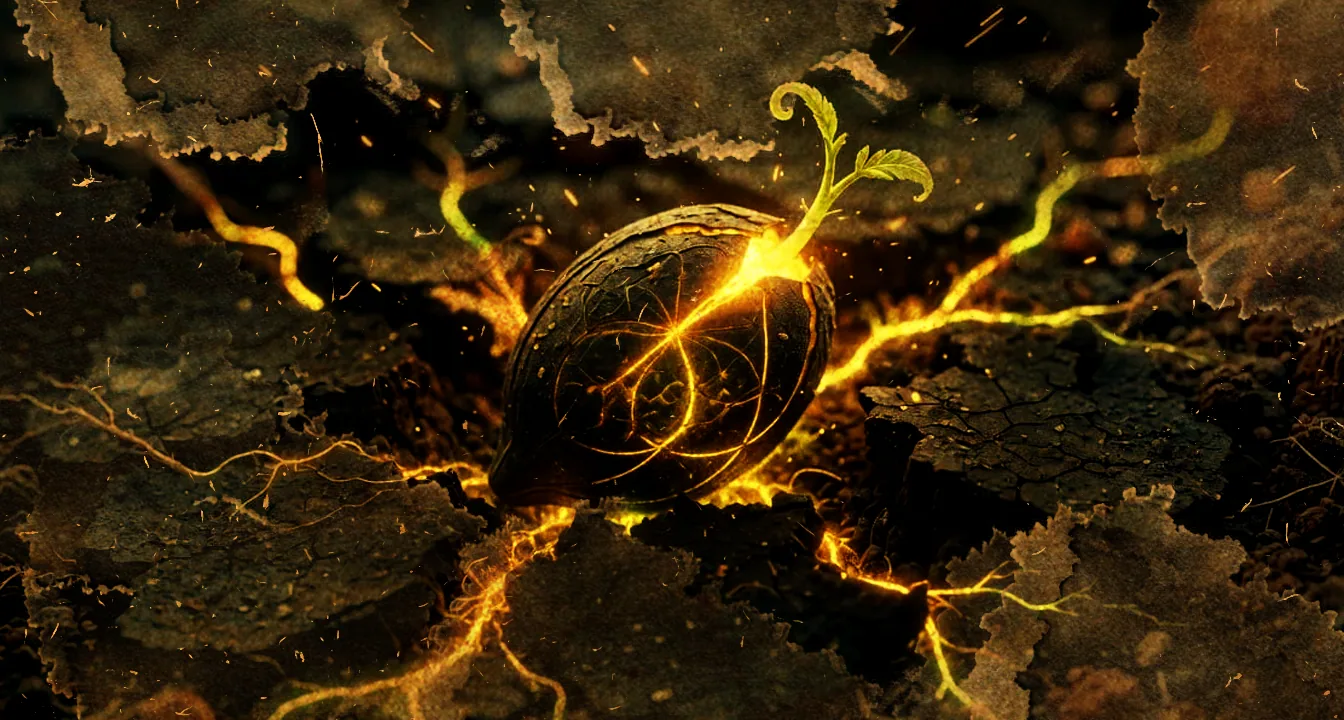
When the Seed was finally restored, they carried it to the northern battlefield before Cord’s Arm. There, after the defeat of the demon hosts and their Helkorian allies, they planted it within the wounded earth. The Tree that stands there today is a living testament to rebirth.
The Awakening of the Seed
The planting of the Seed marks the beginning of the present Spire. As its roots entered the ground, the crust of darkness and dust covering the northern lands began to break apart. Theril retreated far from Thera, and his shadow fled before the authority of life. Light returned to the surface, rivers shed their muddy corruption, and nations slowly returned to lands that had remained barren throughout the years of Nightfall.
The Tree did not restore all of northern Therasya at once, nor did it cleanse Othmog. Its influence spread gradually, allowing the mortal kingdoms to rebuild. The Thergen used this renewal to begin the Campaign of Anvils, reclaiming the approaches to Cord’s Arm and restoring fortifications that had remained under demonic occupation. Long had they sheltered within their underground cities and forts, listening to demonic feet tread through their upper chambers and across their mountains.
The Tree became the living symbol of that victory. To the Alliance, it represents the survival of the mortal races. To the Thergen, it marks the point where lands once trampled by the armies of Darkness were reclaimed beneath the protection of the Wall. To the Fey, it is the rebirth of an inheritance believed lost. To the demons of Othmog, it is an intolerable affront from Harmony upon their frontier.

The Living Vale
The Tree grows at the centre of a vast crater approximately one hundred metres deep. Its upper branches spread across much of the hollow, forming a canopy almost twice the width of the crater’s depth. The trunk is immense, frequently compared in breadth to the great Cathedral of Sermon in Wingspyre.
The surrounding crater is known as the Living Vale. Its boundary is visible, yet it gradually fades into the low vegetation of the surrounding lands. Outside it, the ground remains eroded by magic, blackened by war, and marked by Thergen ruins. Within it, grass, flowering plants, moss, and trees cover the soil. The air becomes cooler and carries moisture, while the magical storms that scour the surrounding plains weaken before reaching the inner vale.
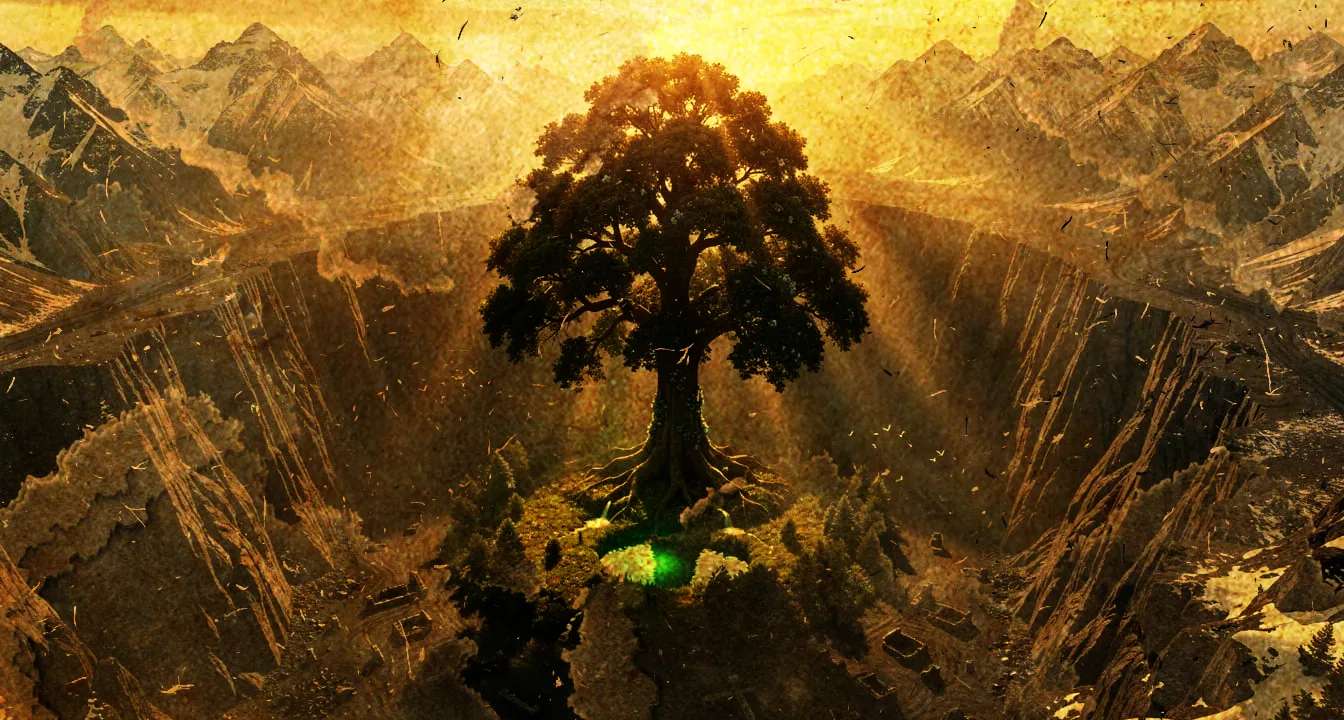
Streams of clear water emerge among the Tree’s roots and gather into pools before disappearing beneath the earth. Priests of Ydor believe the roots draw it from deep, clear veins beneath Thera, while Feyan scholars argue that the Tree produces part of it through its power to sustain life.
Birds nest within the hollows of the trunk, and small animals live beneath the canopy. Many of these creatures are otherwise unknown in the northern lands, where the Haze heavily alters those living beyond the Zaks. Whether they migrated to the Tree or emerged from its magic remains uncertain, but they bear no mutations or signs of Haze exposure.
The Tree’s leaves are dark green with faint bronze tones that become more visible at sunrise. Its bark is covered with clusters of bluish flowers, some growing directly from deep folds in the trunk. These flowers do not follow a known season and have been observed blooming even when the surrounding lands are frozen or scorched by magic. Fallen leaves are gathered and highly valued beyond the boundary of the Living Vale for their healing properties.
The Aura of Life
The Tree produces a powerful aura extending throughout the Living Vale. Exhausted travellers recover quickly beneath its branches, minor wounds close with unusual speed, and diseases often weaken after prolonged exposure. Sleep beneath the canopy is deep and usually free from nightmares.
The effect is strongest upon creatures aligned with life and Harmony. Priests, Thergen, and uncorrupted mortals frequently describe a sensation of warmth spreading through the body. Some hear a low voice resembling a mother comforting a child, although no clear words have ever been recorded.
The corrupted experience the Tree differently. Demons cannot enter the inner vale while Zoodotis shines upon it, although accounts of lesser creatures of Entropy burning, withering, or fleeing upon crossing the boundary still survive in Thergen tomes. More powerful demon lords can resist the aura, just as they can endure sunlight for a time, but their strength gradually fails and their bodies begin to break apart.
Beings carrying lesser forms of corruption suffer pain and weakness. The Korrs and others whose bodies have been permanently altered by demonic influence do not dare approach the crater for fear that it would destroy them together with the corruption embedded in their flesh. Some believe, correctly, that the Tree could cleanse them. If they endure the pain and survive the fever, they emerge cured of Othmog’s touch.
The Fallen produce the most uncertain reaction. Some collapse immediately upon entering the vale, while others stand motionless, as though listening to something beyond mortal hearing. No Fallen has ever remained beneath the Tree long enough for scholars to determine whether its lost soul could somehow be restored.
An Unbreakable Living Work
No known instrument, weapon, or spell has ever injured the Tree, although it offers no visible defence, awakens no guardian, and inflicts no harm upon those who attempt to damage it. Any harmful act is strictly forbidden under penalty of exile to the demon lands. Although attempts have been made, none officially succeeded before the Sacred Guard intervened.
Harvesting is also prohibited, and the Tree is guarded day and night by its dedicated garrison. The law has given rise to several myths claiming that the Tree is indestructible, a statement not yet proven.
On rare occasions, however, a flower or leaf separates naturally and falls into the hands of a visitor. Such gifts retain traces of healing power for several days before dissolving into bronze dust.
The Seed Yet to Come
Since its planting almost three hundred years ago, the Tree of Life has not produced a seed. Priests still pray that one will emerge during a period of crisis, enclosed within an enchanted fruit whose appearance will cause the canopy to shine.
Descriptions of the original Seed portray it as a smooth green stone marked by veins of bronze light. Fallen leaves are consumed by members of the stationed garrison and are believed to offer health and longevity.
If a seed is ever produced, the Alliance has already chosen the guardians to whom it will be entrusted. Their identities and locations remain unknown, and any surviving record has either been concealed or destroyed.
The existence of any seed would become a closely guarded mystery, since it might possess the power to restore a dying land, raise another Tree of Life, or renew the world after the next Darkness. In the wrong hands, however, a seed might be twisted into a source of corruption unlike anything Othmog has yet produced.
Guardianship and Access
The Tree is protected by Cord’s Arm, the local armies stationed within the Zaks, and its own Sacred Guard, yet it remains close to territory threatened by Othmog. Reaching it requires military permission and an armed escort led by Haze Rift rangers, who are responsible for the conduct and safety of the pilgrims.
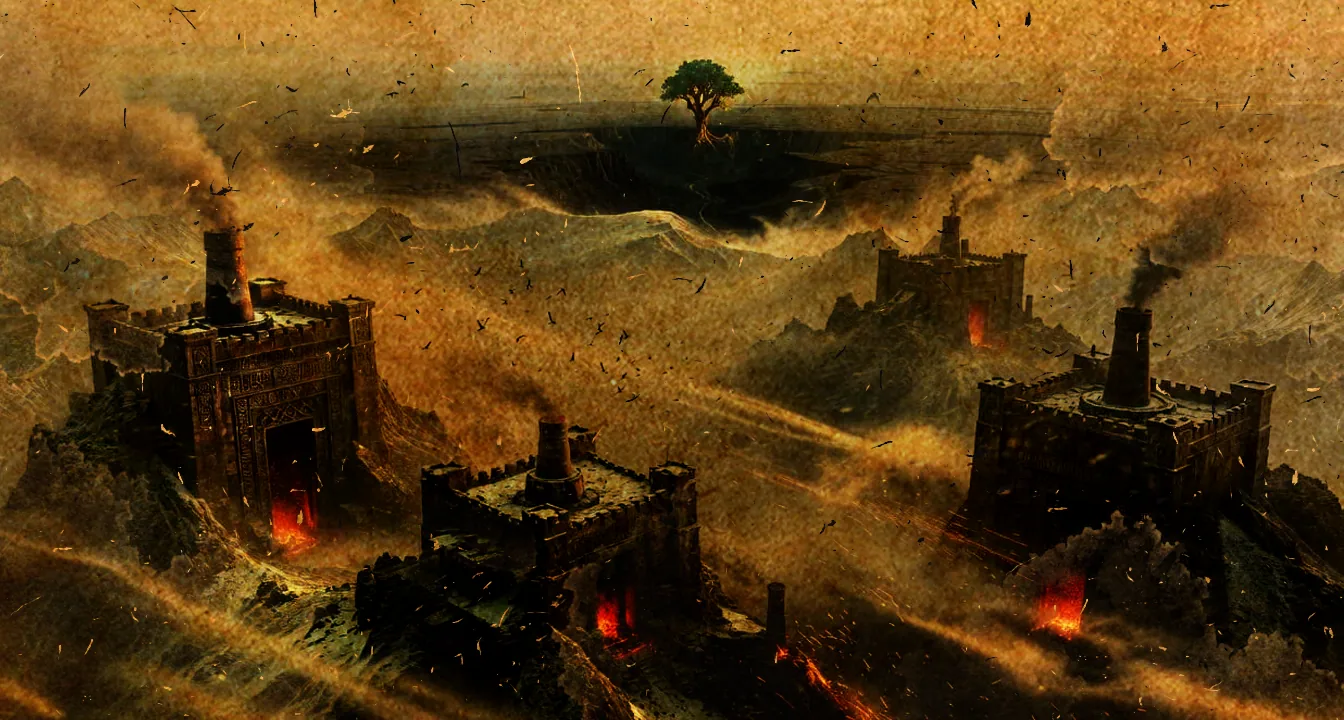
The route is open only during periods of secure daylight. At night, Haze creatures move through the surrounding coasts and attempt to isolate travellers before they can return to the Zaks. During complete Darkness, access to the Tree will become nearly impossible, and the forces stationed near it will withdraw to the Arm, except for its oath-bound guardians.
The Living Vale is watched by a small, rotating detachment drawn from the Alliance, positioned in nearby towers that also form part of the larger fortress network of the Zaks. No permanent city has been constructed around the Tree. Fey emissaries have rejected several proposals to fortify the crater, fearing that walls, roads, and large settlements would disrupt the natural surroundings.
Threats from Othmog
The Archdemons have not yet launched any large-scale attempts to destroy or corrupt the Tree. The few direct attacks launched by demonic agents have failed, as demon magic weakens within the Living Vale and large armies cannot remain exposed beyond Cord’s Arm during daylight.
More subtle efforts continue to this day. Demonic agents have poisoned streams outside the vale, sent corrupted creatures beneath the soil, infiltrated pilgrim groups, and spread false reports concerning the supposed effects of consuming the Tree’s bark and leaves. Helkorian chroniclers describe the Tree as a parasitic weapon of the southern nations, claiming that its roots imprison the souls of those who died during the Battle of the Seed.
The greatest fear is not that Othmog will cut down the Tree, but that it could discover a way to turn its power against life. Some Loreseekers warn that a corrupted Living Vale could spread demonic growth across the entirety of Thera’s Spine. Others believe the Tree cannot be corrupted at all and that the Archdemons instead seek to destroy it so that the world cannot renew itself after the next Darkfall.
Preparing for Darkness
The Tree of Life is not proof that Othmog has finally been defeated. Yet its presence signifies that, while the war continues, chaos has not prevailed.
Its roots descend through a battlefield. Its branches cast shade over the bones of the last war.
Its roots descend through a battlefield. Its branches cast shade over the bones of the last war. Beyond Cord’s Arm, north of the vale, the land remains barren, and farther still the armies of Othmog gather again beneath Theril’s darkness.
Yet the Tree has endured for almost three centuries, and when it finally bears a seed, it will signify the rebirth of hope.