The Feyan Pyramids are monuments of the lost Feyan Empire, still humming with the power of planar portals and light.
“I have visited many places during my adventuring life, but when I stood among the ruins of the ancient Feyan cities, I was captivated by the magnitude of their Works and the dedication evident in their art. Their magnificent pyramids have stood upon the lands of Therasya for thousands of years, enduring as architectural wonders of our world.”
Thend of Zerm · Master Loreseeker
Four Feyan Pyramids are known to have survived the great destructions of the past Spires: Lunar, hidden among the mountains of Kinetika; Maelin, standing near the borders of Zargovia, Andor, and Lydoria; Anthia, rising from the Cursed Desert; and Ilis, concealed upon the distant island of SinBa. Other pyramids may once have existed, but no reliable record of them remains, and if any survived, they lie buried beneath ruined kingdoms, the Sea, or lands now claimed by Entropy.
The pyramids were not constructed merely as palaces, temples, or places of refuge. They were complete Feyan cities, designed to house thousands beneath a single harmonious structure. Their broad lower levels contained markets, residences, workshops, schools, shrines, and gardens, while their upper terraces were reserved for temples, observatories, ruling chambers, barracks, and spaces dedicated to sacred ceremonies. Every level was arranged according to principles of balance and symmetry, so that the entire pyramid reflected the ancient Feyan belief that civilization, nature, magic, and faith should exist as one. The structures extend deep into the earth through foundations, corridors, and caverns, a design that greatly influenced the ziggurats of present-day Elemendia.
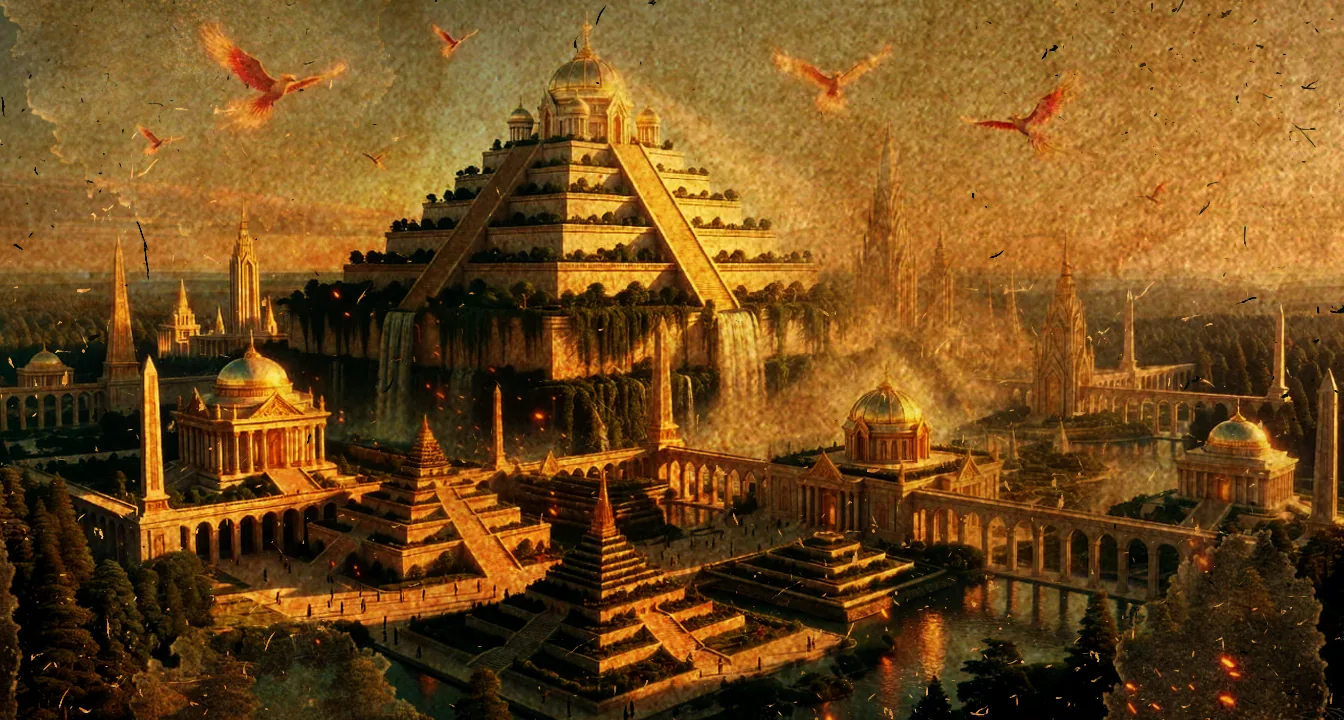
Their outer walls rose in immense, carefully measured tiers. They are almost identical in size, rising two hundred feet in height, with bases approximately four hundred feet wide and four hundred feet long. Grand stairways crossed the exterior, joining terraces covered with gardens, pools, statues, and flowering trees. Even from many miles away, travelers could see green life climbing their stone walls as though entire forests had been lifted into the sky.
Running water was among the most remarkable characteristics of their design. Hundreds of narrow streams passed through the interior halls, feeding fountains, baths, gardens, and clear ceremonial pools. Some flowed from one level to another through channels carved into the walls, while others spilled from the outer terraces in slender waterfalls. The sound of moving water echoed throughout the pyramids, carrying life and coolness into even their deepest chambers.
The inner halls were decorated with statues of the Eternals, phoenix guardians, nature scenes, and heroes from the earliest Spires. Many of the statues were not merely decorative. Ancient accounts claim that some moved, spoke, or awakened when the pyramid was threatened. Phoenixes were particularly common, for the Fey regarded them as symbols of Zoodotis, renewal, and life enduring destruction.
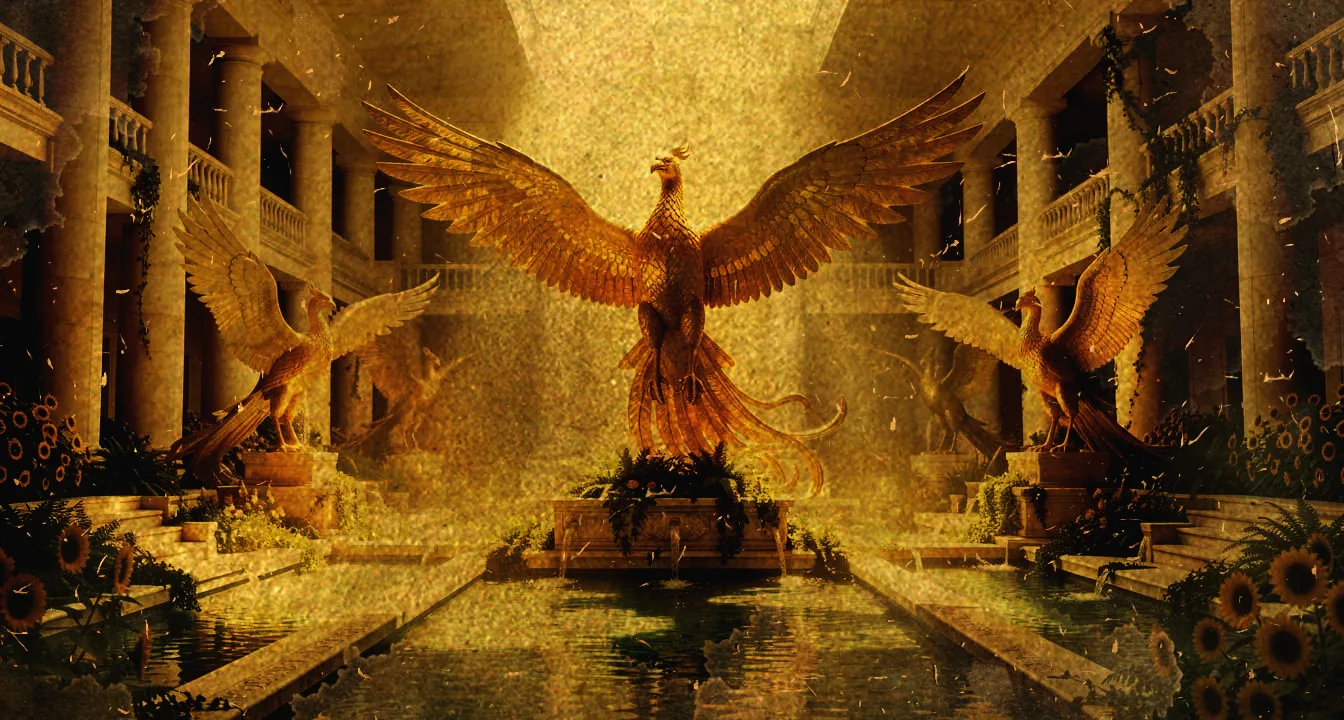
The three Eternals most highly honored within the pyramids were Astarte, Maat, and Zoodotis. Their temples occupied the highest and most sacred levels, although lesser shrines could be found throughout the cities.
The temples of Zoodotis were decorated with gold and polished crystal, reflecting sunlight through their chambers and casting brilliant beams across the surrounding lands. The temples of Astarte were surrounded by gardens, orchards, and pools of crystal water, honoring fertility and the renewal of life. The temples of Maat were built from white stone and filled with a pure radiance said to reveal falsehood and make deception difficult within their walls.

The Hidden Purpose
Ancient Loremasters suggested that the four pyramids once served a greater purpose. When fully awakened, each enclosed a stable portal linked to one of the planes of the cosmos. The exact destinations of the individual pyramids are no longer known, for much of this knowledge vanished with the ancient Fey, but traces of this power can still be detected within their deepest chambers, where a particularly strong connection to the Plane of Light remains.
Some scholars believe that the constant rivers and gardens were sustained by these portals. Others claim that the pyramids drew energy from the Elemental Planes and distributed it throughout their cities through enchantments that powered wards, lights, healing chambers, and Feyan Works whose purposes have long been forgotten.
The Book of Tamlil speaks of two additional pyramids, now lost, which may have opened paths to the planes of positive and negative energy. No ruins have been conclusively identified, and many Loreseekers dismiss them as allegory. Yet the survival of the four known pyramids suggests that the Feyan network may once have been far greater than present knowledge can reveal.
The old power may be lost, or it may simply be sleeping, awaiting those capable of awakening it.
The Gnomes of Kinetika have devoted generations to studying the remaining mechanisms. They have restored fragments of Lunar’s old systems, but even their greatest engineers admit that the pyramids were created through a union of architecture, faith, and magic that cannot easily be reproduced. The old power may be lost, or it may simply be sleeping, awaiting those capable of awakening it.
Lunar
As a citizen of Kinetika and a member of the Order of the Loreseekers, I have had the honour of visiting Lunar many times. Of the four pyramids, it is the best studied and the most closely connected to the history of the current Spire.
Lunar stands among the mountains of Kinetika, surrounded by ancient Feyan ruins and later Gnomish constructions. Its upper terraces still retain fragments of their gardens, although much of the original vegetation has been replaced by hardier mountain species. Beneath them lie sealed halls, collapsed passages, and mechanisms whose functions remain uncertain.
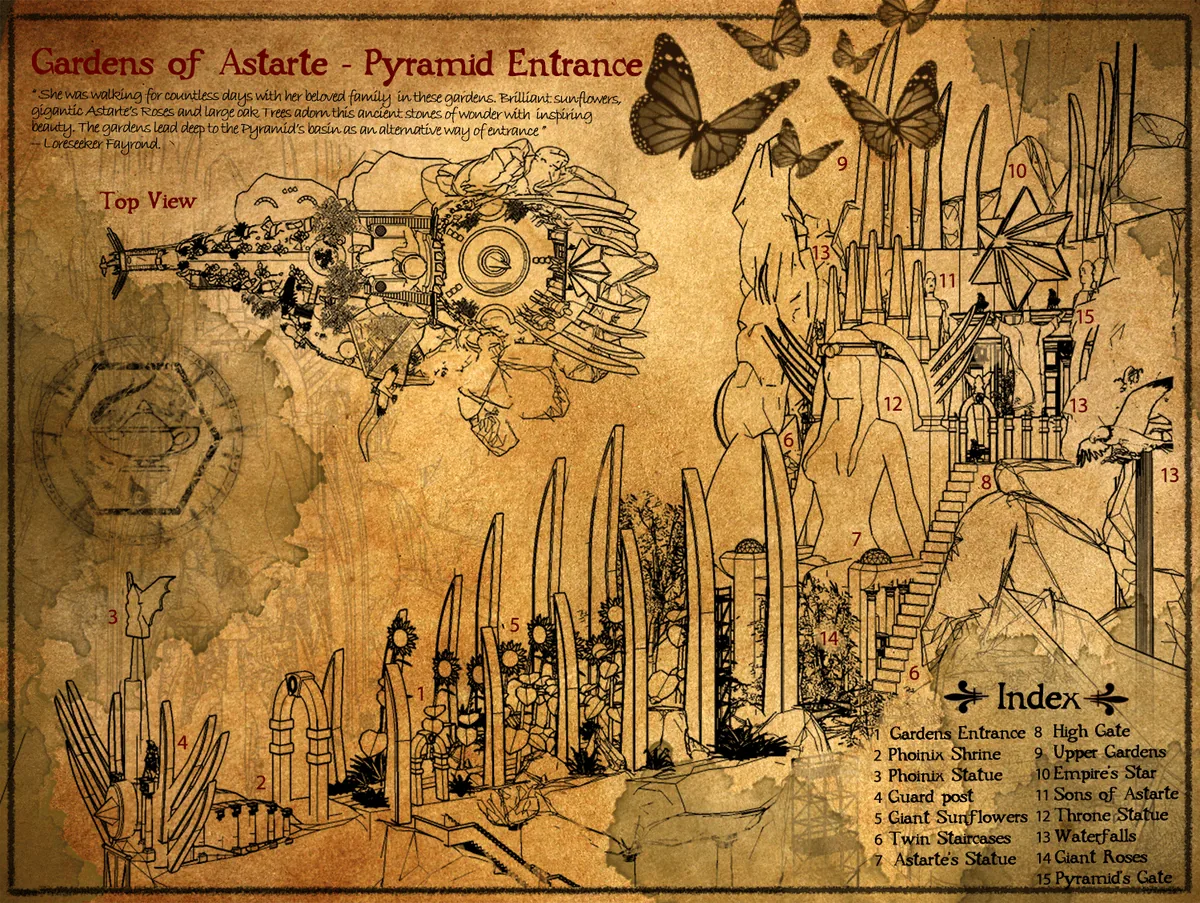
Long after the Fey migrated southward, the Gnomes mounted a colossal white crystal prism upon Lunar’s summit. The crystal was created to gather and reflect the light of Zoodotis across immense distances, serving both as a beacon and as a weapon against creatures that could not endure the sun.
For two and a half years, the light did not fade.
During the North Ride, the Dark Fey Ienelith seized Lunar with the aid of Lienmar beasts and giants. Through the pyramid and its prism, she unleashed an unnatural radiance across Therasya. For two and a half years, the light did not fade. Surface demons were burned from the northern lands, Othmogian strongholds were shattered, and countless creatures of Entropy fled into the deepest caverns to escape destruction.
Yet the light offered no mercy to the mortal nations. Crops withered beneath the unending brilliance, rivers diminished, and lands far from the fighting were scorched. What began as a weapon against Othmog became a catastrophe that contributed to famine and suffering throughout the southern realms.
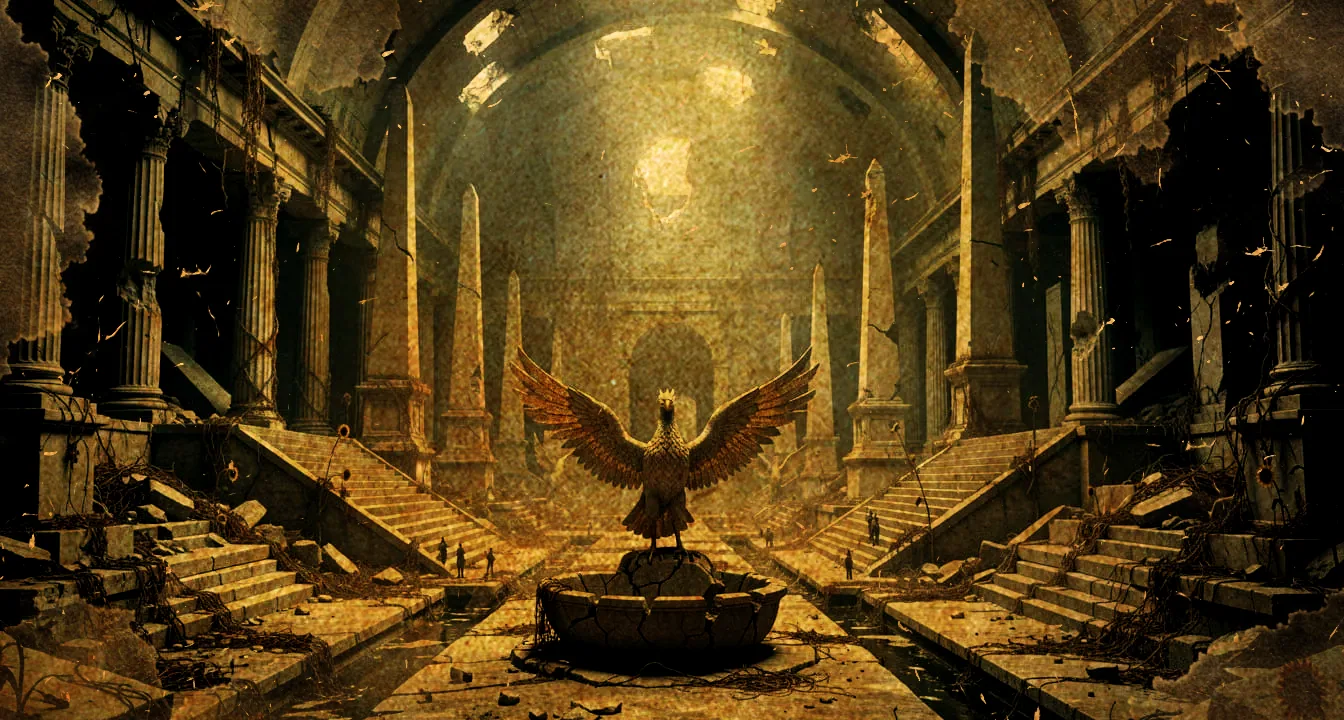
The Lunar Pyramid was eventually reclaimed, but much of its highest structure was damaged during the conflict. In the final battle between false Erin and the Archangel Gregorian, the spell was shattered along with the prism. Although part of the broken structure still remains upon Lunar, several of its fragments were hurled into the skies.
The Gnomes have since financed expeditions to retrieve the prism fragments, but at least four remain deep in the north beneath Theril’s darkness and dozens have spread in remote places of the South. The shattered prism remains one of the most feared relics in Therasya, for it proved that the pyramid could magnify the power of Zoodotis across nearly the entire continent. Whether such power could ever be safely restored or recreated remains a matter of bitter dispute among the Alliance council, Loreseekers, adventurers, and engineers of Kinetika.
Maelin
Maelin stands near the borders of Zargovia, Andor, and Lydoria. For this reason, it has rarely remained under the uncontested control of a single kingdom. Its surrounding lands have changed hands many times, and every nearby ruler understands the strategic importance of possessing a fortress capable of overlooking three realms.
The pyramid is presently considered a grey territory. Patrols from the neighboring countries watch its approaches, but none has established permanent control over its entire interior. Several lower chambers have been explored, looted, or converted into temporary military positions, while the upper levels remain sealed by ancient wards.
Unlike Lunar, Maelin has no known functioning prism. Its surviving mechanisms appear to be connected to mirrors, hidden channels, and chambers that change their internal arrangement. Explorers have reported entering passages that were absent from earlier maps and returning to halls far removed from where they began.
The three neighboring nations distrust one another too deeply to allow a rival to control Maelin, yet none wishes to damage such an irreplaceable wonder. Thus the pyramid remains watched, contested, and only partially understood.
Anthia
Anthia rises from the Cursed Desert, surrounded by barren lands, Fellborn territories, and the lingering scars of ancient devastation. Its bright tiers can be seen above the desert from a great distance, although storms and heat often distort its outline until it appears to float upon the horizon.
During the years of Darkfall, the Desert Fellborn who remained free of Othmog’s control entered a desperate alliance with the Devils who occupied Anthia. Together, they resisted the advancing demon armies and their own corrupted brethren, surviving the destruction that consumed much of the surrounding region. The alliance endured, and the descendants of those Fellborn continue to provide shelter, troops, and strategic support to the Devils of Asmodeus who rule the lands around the pyramid.
Anthia is therefore not abandoned but occupied by hostile and highly fanatical powers. Its halls have been transformed into fortresses, arsenals, courts, and ritual chambers. Feyan statues remain, but many have been chained, defaced, or altered with infernal symbols. The old gardens have largely died, although black orchards and poisonous flowering plants now grow within forgotten halls, while the exposed terraces are relentlessly scorched by Zoodotis.
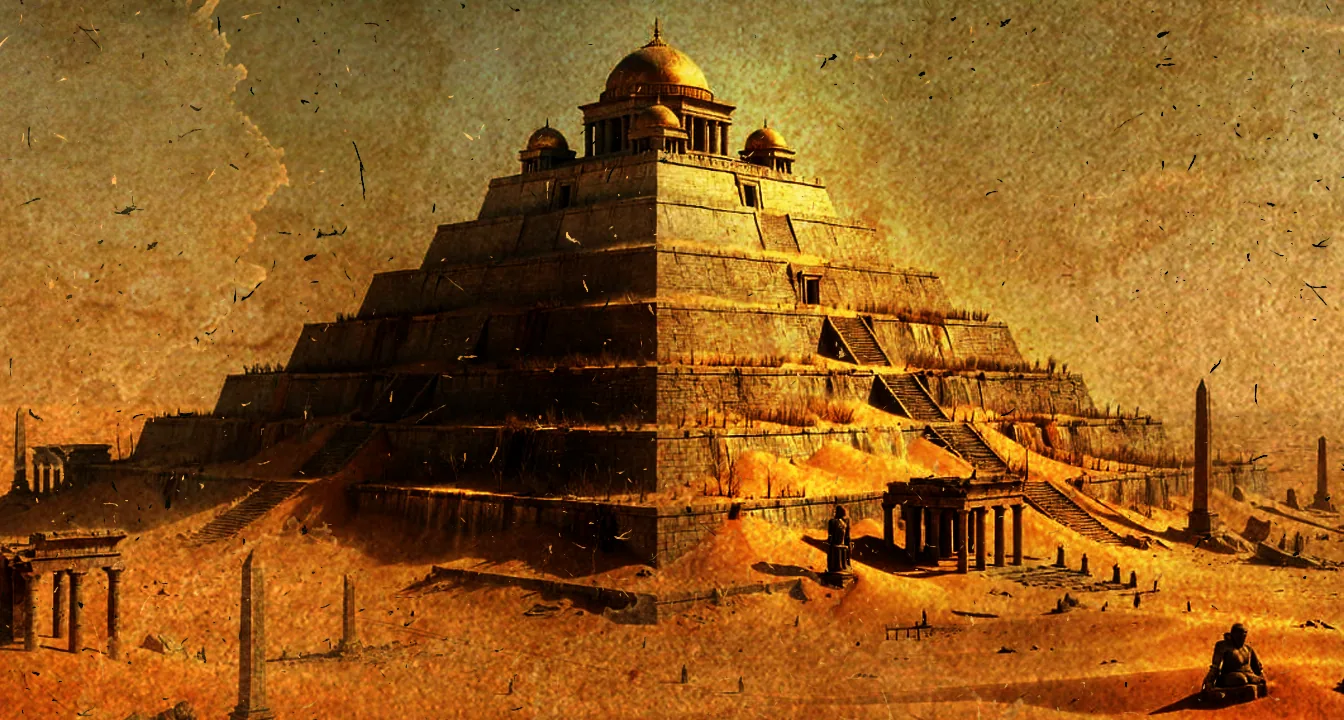
Despite centuries of occupation, the Devils have not mastered the pyramid completely. Sealed Feyan sanctums remain beyond their reach, and lights are sometimes seen moving behind walls that no known passage can enter. The deepest levels are closed even to their Fellborn allies, suggesting that the Devils have either discovered something of great value or awakened something they cannot yet fully control.
Ilis
Ilis remains the greatest mystery of the four surviving pyramids. It stands upon the island of SinBa, far from the routes most commonly travelled by the Order of the Loreseekers. The island’s dense forests, reclusive inhabitants, ancient protections, and isolation have prevented any complete survey.
Only a few travelers claim to have seen the pyramid directly. Their accounts describe stone terraces overwhelmed by jungle, waterfalls descending through trees rooted upon the upper levels, and enormous flowers growing from cracks in the walls. Some insist that the pyramid appears untouched by age, while others describe it as a living ruin slowly being absorbed into the island.
The people of SinBa reveal little about Ilis. They do not appear to fear it, yet neither do they encourage outsiders to approach. Certain Sinbadian tales suggest that the pyramid remains active and that its gardens are tended by spirits, Feyan guardians, and creatures that have never left its halls, all under the command of a great phoenix.
Ilis may therefore be both the best-preserved and the least understood of all the pyramids. It remains my greatest ambition to visit it before the time comes for my soul to return to the Pool.
Legacy
The Feyan Pyramids are among the greatest surviving Works of the ancient world. They were cities, fortresses, offerings to the Eternals, and possibly planar gates united within a single design. Each represents a fragment of a civilization that achieved wonders the modern kingdoms can study but rarely reproduce.
They are not dead monuments. Their waters still move, their wards still awaken, and unseen energies continue to pass through their deepest chambers. The ancient Fey may have vanished from them, but their Works endure, whispering across the Spires to those wise or reckless enough to listen.
“Stone remembers what flesh forgets. Somewhere beneath the vines, the dust, and the long silence, the old rivers still recall the shape of the sky they once carried.”
Feyan proverb · preserved by the Order of the Loreseekers